
What to Expect at a DSA Coding Interview (And How to Prepare Your Child)
The hardest part of the Direct School Admission (DSA) journey isn’t the application form. It’s what comes next.
By early June, the DSA-Sec application window has closed and the waiting begins. For families whose child applied under a computing, robotics, or science-and-engineering talent area, the real test is the interview, trial, or audition that schools run over the coming weeks — usually between June and August, with outcomes released directly by schools by late August.
This is the stage where a strong application becomes an offer, or doesn’t. The good news: a coding DSA interview rewards exactly the things your child has been building all along — genuine curiosity, the ability to think through a problem, and real ownership of the things they’ve made. You can’t cram those overnight, but you can absolutely help your child walk in prepared and calm.
Here’s what these assessments actually look like, what schools are listening for, and how to prepare your child without turning the next two months into a pressure cooker.
Where the interview sits in the DSA timeline
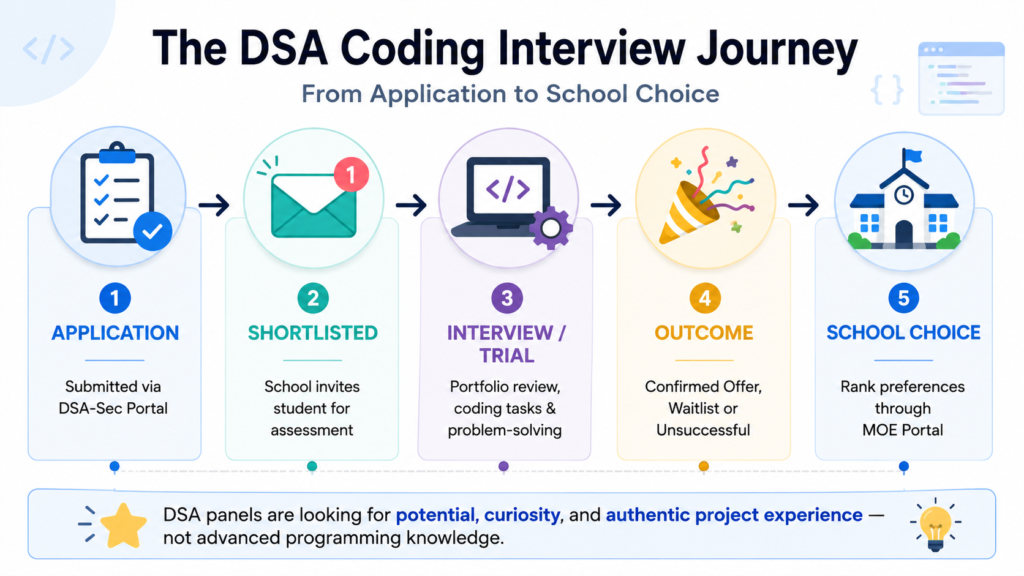
It helps to zoom out first. The 2026 DSA-Sec cycle runs roughly like this:
- Applications: submitted through MOE’s DSA-Sec Portal, closing 2 June 2026.
- Selection activities: shortlisted students attend interviews, auditions, or trials run by individual schools, mostly across June to August. Each school sets its own format and schedule.
- Outcomes: schools notify families of a Confirmed Offer, Waitlist, or unsuccessful result by 28 August 2026.
- School preferences: if your child receives offers, you rank choices through the portal by 23 October 2026, with placement confirmed alongside PSLE results.
So if your child is shortlisted, the selection activity is the moment everything hinges on. Watch your email closely — shortlisting notifications and assigned interview slots come directly from the schools, and slots are rarely rescheduled.
What a coding DSA assessment usually involves
There is no single national format. A school admitting for a computing or science-and-engineering talent will design its own process, so always read the talent-area page on that school’s website carefully. That said, coding-related DSA assessments tend to draw from four common components:
1. A portfolio walkthrough. Your child is asked to talk through the projects they submitted — a game, an app, a robotics build, a Python script. Assessors want to hear how it was made and why certain choices were taken, not just see the finished product.
2. A technical or problem-solving interview. This might involve explaining how a piece of their code works, reasoning aloud through a logic puzzle, or describing how they’d approach a problem they haven’t seen before. The thinking matters more than a perfect answer.
3. An on-the-spot task or trial. Some schools set a short hands-on challenge — debugging a snippet, sketching the logic for a simple program, or a block-based or unplugged problem for younger applicants. It’s designed to see how your child works, not to trip them up.
4. A motivation and fit conversation. Expect questions like “Why do you enjoy coding?”, “What do you want to build next?”, and “Why this school’s programme?” Schools are choosing students who’ll thrive in their environment for the long haul.
Younger applicants (think Primary 6 entering Secondary 1) are generally assessed on potential and genuine interest rather than advanced technical depth. The bar is “Does this child light up when they talk about what they’ve built?” far more than “Can they implement a sorting algorithm?”
What assessors are actually looking for
Parents often assume DSA panels want the most polished, most advanced applicant in the room. They usually don’t. What consistently stands out:
- Authentic ownership. A child who clearly built their own project and can explain every part of it beats a flashier project they can’t account for.
- Clear thinking under uncertainty. The ability to say “I’m not sure, but here’s how I’d figure it out” is gold. Coding is problem-solving, and panels are watching the reasoning.
- Curiosity and initiative. Evidence that your child explores, tinkers, and learns beyond what’s assigned — a self-started project, a bug they chased down, a tool they taught themselves.
- Communication. Being able to explain a technical idea in plain language is a genuine signal of understanding.
- Coachability and fit. Schools invest six years in DSA students. They want someone who’ll grow with the programme.
Notice what’s not on that list: a perfect, error-free demo. Panels expect work that’s still rough at the edges — that’s what real student projects look like.
How to prepare your child (without the pressure)
You have a window of a few weeks between shortlisting and the interview. Use it well, but keep it light. Children interview far better relaxed than rehearsed into rigidity.
Know the portfolio cold. Sit with your child and have them explain each submitted project out loud, as if to a stranger: what it does, how they built it, what was hard, what they’d improve. If they can’t explain a part, that’s the part to revisit.
Practise thinking out loud. Coders are often quiet problem-solvers. Get your child comfortable narrating their reasoning — “first I’d check this, then I’d try that.” It feels unnatural at first and pays off enormously in interviews.
Refresh the fundamentals. Light revision of the concepts behind their projects — loops, conditionals, variables, basic logic, or the relevant robotics/Scratch/Python ideas for their level. The goal is confidence, not new material.
Prepare the “why” answers. Help them put words to why they love coding, what they’ve made that they’re proud of, and what they hope to do at this specific school. Specific and honest beats grand and generic.
Run one or two gentle mock interviews. Have a family member or mentor ask a few likely questions and give a hands-on task to talk through. Keep it friendly. The aim is familiarity with the format, not perfection.
Sort the logistics. Confirm the date, time, venue, and what to bring (laptop, project files, a printed portfolio if requested). Plan to arrive early. A calm morning makes a real difference.
Common mistakes to avoid
- Over-rehearsing answers until they sound scripted. Panels can tell, and it works against the authenticity they’re after.
- Submitting or showcasing projects your child can’t fully explain — including anything heavily helped by a parent or tutor. It tends to surface in the conversation.
- Treating it as a test to “win” rather than a conversation. Children who relax and talk about something they enjoy come across best.
- Neglecting the soft skills. Eye contact, listening to the question asked, and a willingness to say “I don’t know yet” all matter.
- Cramming new, advanced content in the final week. It rarely lands and often rattles confidence.
A healthy perspective on the outcome
It’s worth saying plainly: DSA is one pathway, not the only one. Up to 20% of places at non-Integrated-Programme schools are filled this way, which means the vast majority of students enter secondary school through PSLE posting and do wonderfully. A waitlist or an unsuccessful result is not a verdict on your child’s ability or their future in tech.
Whatever the outcome, the preparation itself is valuable. Learning to explain your work, reason through problems, and talk about what you love is a skill set that serves a young coder for years — at any school they attend.
So encourage your child, prepare them, and then let them enjoy the conversation. A young person talking about something they genuinely built and care about is exactly what these panels hope to meet.
Frequently asked questions
1. When are DSA coding interviews held?
For the 2026 cycle, shortlisted students attend school-run interviews, trials, or auditions mostly between June and August, after applications close on 2 June. Schools notify outcomes by 28 August 2026.
2. Which DSA talent area does coding fall under?
Coding, robotics, and computing typically sit within the Science, Mathematics and Engineering talent category, though some schools run their own computing- or innovation-specific programmes. Always check the individual school’s talent-area page.
3. Does my child need to be an advanced programmer to pass a DSA coding interview?
No. Panels prioritise genuine interest, clear problem-solving, and ownership of their work over advanced technical depth — especially for Primary 6 applicants, who are assessed largely on potential.
4. How long does a DSA coding interview take?
It varies by school. Many run between 20 and 60 minutes and may combine a portfolio discussion, a short technical or problem-solving component, and a conversation about motivation and fit.
5. What should my child bring?
Whatever the school specifies – commonly a laptop with their project files, and sometimes a printed portfolio. Confirm the requirements in your shortlisting email and arrive early.